
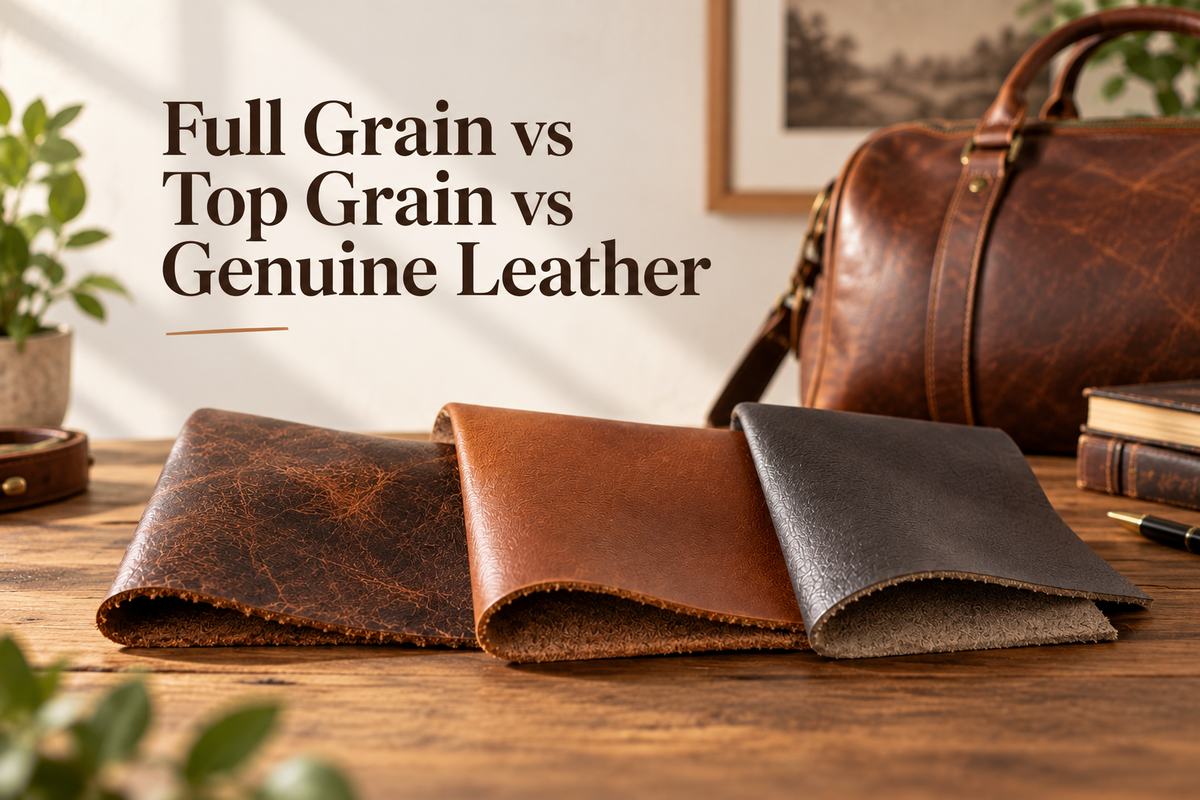
When buying leather goods, full grain, top grain, and genuine leather are not interchangeable terms. Full grain leather retains the natural grain of the hide, top grain leather is processed to create a more uniform surface, and genuine leather is a broader term used for real leather that does not necessarily indicate a particular grade.
Understanding these differences can help you choose better leather products based on durability, appearance, feel, and intended use. Whether you are shopping for a leather briefcase, handbag, wallet, or travel bag, knowing what is behind the label makes it easier to compare your options.
Full Grain vs Top Grain vs Genuine Leather at a Glance
The simplest way to understand the difference is to look at how much of the natural hide each type retains and how extensively its surface is processed.
|
Leather Type |
Natural Grain |
Surface Processing |
Appearance |
Aging |
|
Full Grain Leather |
Retained |
Minimal |
Natural and textured |
Develops a distinct character |
|
Top Grain Leather |
Upper grain retained |
More processed |
Smooth and consistent |
Can develop character |
|
Genuine Leather |
Varies |
Varies |
Depends on processing |
Depends on leather and finish |
The biggest distinction is that full grain and top grain describe specific parts of the hide, while genuine leather is a broader description of real leather.
What Is Full Grain Leather?
Full grain leather is leather that retains the natural grain of the hide with minimal surface alteration. Because the outer surface remains largely intact, full grain leather can retain natural markings and variations while offering excellent durability.
These characteristics make full grain leather particularly suitable for products that are expected to be used regularly. Briefcases, work bags, travel bags, crossbody bags, totes, and wallets can all benefit from the strength and natural character of this type of leather.
Saddle Leather Goods uses full grain buffalo leather across a number of its products. For example, The Signature Leather Briefcase combines full grain buffalo leather with cotton lining, brass hardware, and industrial marine-grade polyester thread.
What Is Top Grain Leather?
Top grain leather comes from the upper portion of the hide but is generally processed to create a cleaner and more consistent surface. It retains many of the qualities associated with premium leather while offering a more uniform appearance.
The surface may be sanded or corrected to reduce visible marks. This makes top grain leather appealing to buyers who prefer a polished finish and consistent texture. However, the leather grade should always be considered alongside construction, stitching, hardware, and the overall quality of the finished product.
What Is Genuine Leather?
Genuine leather means the product is made from real leather, but the term does not necessarily tell you which part of the hide was used or how extensively it was processed. It should therefore not be treated as a guarantee of premium leather quality.
When comparing genuine leather vs full grain leather, remember that these terms describe different things. Full grain identifies a specific portion of the hide, while genuine leather is a much broader description. If a product is simply labeled genuine leather, look for additional information about the material and construction before buying.
Choose the Most Durable Leather
Full grain leather is generally considered the most durable leather grade because it retains the natural grain and structure of the hide. However, the durability of a finished leather product depends on much more than the leather grade alone.
Before judging a leather bag, examine the construction as a whole.
Stitching
Consistent, secure stitching is especially important around handles, straps, corners, and other areas that experience repeated stress.
Handles and Straps
Handles and straps need strong attachment points because they carry the weight of the entire bag. Poorly reinforced attachments can become a weakness even when the leather itself is excellent.
Hardware
Buckles, rings, closures, and zippers should be appropriately sturdy for the size and intended use of the product.
Edges
Cleanly finished edges can help a leather product withstand repeated handling while contributing to its overall appearance.
Overall Construction
A well-made leather product should feel thoughtfully constructed from the inside and outside. The leather, lining, stitching, hardware, and design should work together rather than relying on the leather alone to create an impression of quality.
Does Full Grain Leather Age Better?
Full grain leather is particularly known for developing a patina, meaning its appearance gradually changes through use. Instead of remaining exactly as it looked when new, the leather can become deeper in color and develop variations in texture that reflect how it has been handled.
The rate and appearance of this aging depend on the leather, finish, frequency of use, environment, and care. For people who appreciate natural aging, this changing character is one of the biggest advantages of choosing full grain leather.
How Can You Tell If Leather Is Good Quality?
Good-quality leather should be evaluated by looking at both the material and the finished construction. A leather grade tells you something about the hide, but stitching, hardware, edges, lining, and workmanship also influence how well a product performs.
Look at the Grain
Natural variation in the grain can indicate that the leather has retained more of its original character. Full grain leather can show subtle differences in texture and markings because its surface has not been heavily corrected.
Check the Feel
Quality leather generally has a substantial, natural feel rather than feeling excessively thin or artificial. The exact feel varies according to the hide, thickness, finish, and tanning process.
Examine the Edges
Look closely at the edges of handles, straps, panels, and pockets. Properly finished edges should appear clean and consistent because these areas experience frequent handling.
Inspect the Stitching
Look for consistent stitching, particularly where handles and straps connect to the body of the product. These points experience considerable stress during everyday use.
Test the Hardware
Buckles, rings, closures, and zippers should feel appropriate for the product. Strong leather paired with weak hardware can still result in a product that does not hold up well.
Look at the Construction
Quality should be visible throughout the product rather than only on its exterior. Check the lining, pockets, seams, handles, hardware, and other details to understand how carefully the product has been made.
Full Grain vs Top Grain: Which Should You Buy?
Choose full grain leather if you value natural texture, durability, and the way leather develops character with age. Choose top grain leather if you prefer a smoother and more consistent appearance while still wanting a quality leather material.
Neither option is automatically right for every buyer. Your intended use should influence the decision just as much as the leather grade. A formal work bag, for example, may benefit from a more uniform finish, while a travel bag may be chosen specifically for the character that develops through use.
Is Genuine Leather a Bad Choice?
Genuine leather is not automatically a bad choice, but the term alone does not provide enough information to judge a product's quality. It confirms that the material is real leather, but it does not necessarily indicate its position within the hide or the level of processing it has undergone.
Instead of relying solely on the words "genuine leather," look for information about the specific leather, thickness, construction, stitching, hardware, and workmanship. These details provide a much clearer picture of what you are buying and how well it is likely to suit your needs.
Which Leather Is Best for Bags?
Full grain leather is an excellent choice for bags that need to withstand regular use, particularly briefcases, work bags, travel bags, and everyday handbags. Its natural grain provides durability while allowing the material to develop character over time.
Saddle Leather Goods offers full grain buffalo leather bags across several categories. The Camelot Leather Crossbody Bag, for example, is made from full grain buffalo leather and features an interior zip pocket and three exterior zip pockets for everyday organization.
Choose Leather Based on How You Use It
The best leather is not simply the one with the most impressive label. It is the material and construction combination that fits how you plan to use the product.
If you want natural character and long-term durability, full grain leather is a strong choice. If you prefer a more consistent appearance, top grain leather may be more suitable. If a product is described only as genuine leather, investigate the specific material and construction before making your decision.
Explore Saddle Leather Goods' collection of full grain leather bags and accessories to find a piece designed around the way you actually carry, work, and travel.


